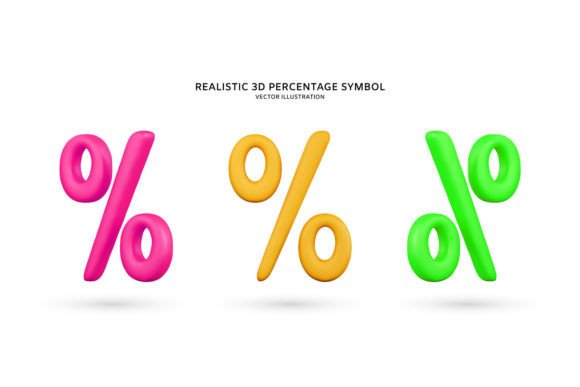
Enhancing Visual Communication with a Realistic 3D Colorful Percentage Symbol
In the rapidly evolving landscape of digital design and data visualization, the ability to convey complex information quickly and effectively is paramount. Among the myriad of symbols used in business, finance, and marketing, the percentage sign holds a unique position. It is not merely a mathematical operator but a powerful visual cue that signifies growth, discount, interest, or statistical change. While standard two-dimensional typography serves its purpose in dense text, modern design trends increasingly favor elements that possess depth, vibrancy, and tactile appeal. This is where the concept of a Realistic 3D Colorful Percentage Symbol becomes an invaluable asset for creators across various industries.
The shift towards three-dimensional aesthetics in user interfaces and marketing materials is driven by a desire for engagement. Flat design, while clean, can sometimes feel sterile or overlooked in a crowded digital environment. A realistic 3D render, particularly one infused with vibrant colors, captures attention immediately. It adds a layer of sophistication and playfulness that can transform a mundane statistic into a compelling visual story. For professionals who rely on high-quality assets to communicate value, understanding the utility and technical specifications of such resources is essential.
The Strategic Value of High-Quality Vector Assets
When integrating graphical elements into professional projects, the format of the file is just as critical as the aesthetic quality. The primary advantage of acquiring a resource like a Realistic 3D Colorful Percentage Symbol lies in its versatility. Typically, premium design assets are delivered in multiple formats to accommodate different workflows. In this context, receiving both an EPS 10 file and a high-resolution JPG file ensures that the user is equipped for any scenario, from web deployment to large-format printing.
The EPS (Encapsulated PostScript) format is the industry standard for vector graphics. Unlike raster images, which are composed of pixels, vector files are built using mathematical paths. This distinction is crucial for scalability. A vector illustration can be enlarged to the size of a billboard or shrunk to fit a business card without any loss in clarity or sharpness. For designers working with Adobe Illustrator, Corel Draw, or other vector editing software, the EPS 10 file provides the ultimate flexibility. It allows for the separation of elements, color adjustments, and structural modifications that are impossible with flat image files.
Conversely, the JPG file serves as an immediate-use asset. For users who may not have access to advanced vector editing tools, or for those who need to quickly insert an image into a presentation, social media post, or document, the high-quality JPG is indispensable. It offers a ready-to-use representation of the 3D symbol, complete with lighting, shadows, and color gradients that define its realistic appearance. This dual-format approach respects the diverse skill sets and software environments of modern creators.
Applications Across Industries and Media
The utility of a colorful, three-dimensional percentage icon extends far beyond simple decoration. Its applications are vast, touching upon several key sectors where visual impact drives engagement.
- Digital Marketing and E-Commerce: In online retail, the percentage symbol is synonymous with sales and discounts. A realistic 3D version can make promotional banners stand out against competitors using generic clip art. The depth and color can evoke excitement and urgency, potentially increasing click-through rates.
- Financial Reporting and Infographics: Financial institutions and fintech apps often struggle to make dry data engaging. Incorporating vibrant 3D elements into infographics can help highlight key performance indicators, interest rates, or investment returns, making the data more accessible to a broader audience.
- Educational Materials: Educators creating content for mathematics or economics can use these visually appealing symbols to capture the attention of students. The realistic nature of the render helps bridge the gap between abstract concepts and tangible visuals.
- Corporate Presentations: Business leaders often need to present growth metrics to stakeholders. Using high-quality, scalable vector graphics ensures that slides look professional on any screen, from a laptop to a large conference room projector.
Each of these use cases benefits from the high-quality vector illustrations that define premium assets. The ability to maintain crisp edges and vibrant colors regardless of the output medium is a non-negotiable requirement for professional-grade work.
Technical Considerations for Designers
For those intending to customize the asset, understanding the technical workflow is essential. The EPS 10 format is compatible with a wide range of legacy and modern software, ensuring broad accessibility. However, to fully leverage the potential of a Realistic 3D Colorful Percentage Symbol, one must utilize a vector editor. Programs such as Adobe Illustrator or Corel Draw allow users to ungroup the elements, adjust the gradient meshes that create the 3D effect, and modify the color palette to align with specific brand guidelines.
It is important to note that while the JPG file provides a snapshot of the design, it is a rasterized image. If you want to edit something, separate elements, or remove something, please use a vector editor. Attempting to edit a JPG in a photo manipulation program like Photoshop will result in pixelation and a loss of quality if the image is resized significantly. Therefore, the vector file should always be considered the master source, while the JPG serves as a convenient derivative.
Furthermore, the "100 Vector File" designation often implies a comprehensive library or a highly detailed single asset constructed from numerous vector paths. This complexity allows for nuanced lighting and shading effects that mimic real-world materials, such as plastic, glass, or metal. Designers can isolate these components to create variations, such as a monochrome version for minimalist designs or a high-contrast version for accessibility-focused layouts.
Enhancing Brand Identity Through Visual Consistency
Brand identity is not just about logos and color codes; it is about the consistent application of visual language across all touchpoints. A generic, flat percentage sign may fail to convey the personality of a modern, dynamic brand. In contrast, a Realistic 3D Colorful Percentage Symbol can be tailored to reflect brand values. For a tech startup, bright neon colors and sleek surfaces might communicate innovation. For a financial consultancy, deeper tones with subtle metallic finishes could convey stability and trust.
By utilizing scalable vector graphics, brands ensure that this visual consistency is maintained across all platforms. Whether the symbol appears on a mobile app icon, a printed annual report, or a large outdoor advertisement, the integrity of the design remains intact. This consistency builds recognition and trust among consumers, who subconsciously associate the high-quality visual presentation with the reliability of the service or product being offered.
Future-Proofing Your Design Library
As display technologies continue to advance, with higher resolutions and wider color gamuts becoming standard, the demand for high-fidelity assets will only increase. Investing in resources that are scalable to any size and easy to use ensures that your design library remains relevant. The transition from standard definition to 4K and beyond renders low-resolution raster images obsolete for many professional applications. Vector graphics, by their very nature, are future-proof. They do not rely on pixel density, meaning they will look equally sharp on today’s screens and the displays of tomorrow.
Moreover, the ease of integration into existing workflows cannot be overstated. The availability of both EPS and JPG formats removes barriers to entry. Teams with mixed software capabilities can collaborate seamlessly, with designers handling the vector customization and marketers utilizing the ready-made JPEGs for quick content creation. This synergy enhances productivity and allows for faster turnaround times on critical projects.
In conclusion, the integration of a Realistic 3D Colorful Percentage Symbol into your design toolkit offers significant advantages in terms of visual impact, versatility, and professional quality. By understanding the technical distinctions between vector and raster formats, and by leveraging the scalability and editability of EPS files, creators can produce work that stands out in a competitive digital landscape. Whether for marketing, education, or corporate communication, these high-quality illustrations provide the foundation for clear, engaging, and effective visual storytelling.