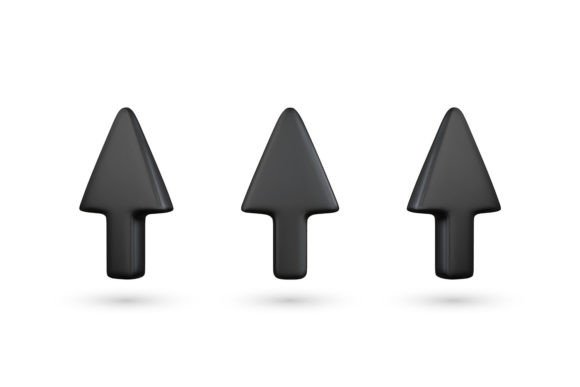
Realistic 3d Black Arrow Vector Icon: Elevating Digital Visual Communication
In the fast-paced world of digital design, clarity is king. Whether you are building a mobile application, designing a corporate presentation, or crafting a social media campaign, the ability to guide the viewer’s eye is essential. This is where the Realistic 3d Black Arrow Vector Icon becomes an indispensable asset. Unlike flat, two-dimensional graphics that can sometimes feel sterile or overlooked, a three-dimensional arrow adds depth, weight, and directionality to your visual hierarchy. It signals movement and intent with a sophistication that flat designs often struggle to achieve without extensive shading work.
The demand for high-quality, versatile graphic elements has surged as businesses and creators strive to stand out in saturated markets. Users today expect polished, professional interfaces that feel tactile and responsive. A realistic 3D arrow does not merely point; it invites interaction. It suggests a next step, a download, or a transition with a level of visual cues that align with modern user experience standards. By integrating such icons into your workflow, you bridge the gap between functional navigation and aesthetic appeal.
The Shift Toward Depth and Realism in UI Design
For years, flat design dominated the digital landscape, stripping away shadows and textures in favor of minimalism. However, design trends are cyclical and evolutionary. We are currently witnessing a resurgence of depth, often referred to as "neumorphism" or refined material design, where subtle shadows and lighting effects create a sense of physicality. The Realistic 3d Black Arrow Vector Icon fits perfectly into this modern aesthetic. It provides the necessary contrast against clean backgrounds while maintaining the sleekness required for professional applications.
This shift is not just about aesthetics; it is about usability. In complex dashboards or dense informational graphics, users need clear signposts. A 3D arrow stands out more effectively than a flat counterpart because it mimics how light interacts with objects in the real world. Our brains are wired to process these visual cues quickly. When a creator uses a high-quality vector illustration like this, they are leveraging cognitive psychology to improve navigation and comprehension. It is a small detail that significantly enhances the overall user journey.
Understanding the Value of Vector Formats
When acquiring digital assets, the file format is just as critical as the visual design itself. This product offers a Realistic 3d Black Arrow Vector Icon in two primary formats: EPS 10 and JPG. Understanding the distinction between these files is crucial for maximizing their utility in your projects.
The EPS (Encapsulated PostScript) file is the powerhouse of this package. As a vector file, it is composed of mathematical paths rather than pixels. This means the image is infinitely scalable. You can shrink it down for a favicon or enlarge it for a billboard without losing a single degree of sharpness. This scalability is vital for professionals who need to maintain brand consistency across various mediums, from business cards to large-format prints. The EPS 10 format ensures compatibility with a wide range of design software, making it a safe and flexible choice for any workflow.
On the other hand, the included JPG file serves as a convenient raster alternative. It is ready to use immediately in documents, web pages, or presentations where editing is not required. Having both formats provides a comprehensive solution: the JPG for quick deployment and the EPS for deep customization and scaling.
Customization and Creative Control
One of the most significant advantages of purchasing a vector file is the level of control it affords the user. While the Realistic 3d Black Arrow Vector Icon comes pre-designed with high-quality shading and perspective, it is not a static image. If you want to edit something, separate elements, or remove something, you can do so easily using a vector editor such as Adobe Illustrator, Corel Draw, or Affinity Designer.
This flexibility is essential for branding. Perhaps your brand guidelines require a specific shade of black, or maybe you need to adjust the angle of the arrow to match the flow of your layout. With a vector file, these changes are non-destructive and precise. You can isolate the shadow layers to change their opacity, tweak the gradient meshes to alter the lighting source, or even combine the arrow with other vector elements to create a unique composite icon. This level of editability transforms a stock asset into a bespoke design element tailored to your specific needs.
Practical Applications Across Industries
The versatility of this icon makes it relevant for a wide array of professionals and industries. Here are several practical scenarios where this asset adds value:
- Digital Marketing: Use the arrow to draw attention to call-to-action buttons in email newsletters or landing pages. The 3D effect increases click-through rates by making the button appear more clickable.
- Presentation Design: Consultants and educators can use the arrow to illustrate processes, growth trajectories, or directional flows in PowerPoint or Keynote slides. The professional look enhances credibility.
- App Development: Developers can import the SVG or EPS paths into their codebases to create crisp navigation icons that look sharp on high-resolution retina displays.
- Print Media: Brochures and flyers benefit from the high-resolution output of vector files, ensuring that printed arrows remain crisp and free of pixelation.
By having a high-quality vector illustration that is easy to use, you reduce the time spent searching for the right graphic or attempting to create one from scratch. This efficiency allows creators to focus on higher-level strategic tasks rather than getting bogged down in minor design details.
Why Quality Matters in Micro-Interactions
In modern web and app design, micro-interactions—the small animations and visual feedback loops—play a huge role in user satisfaction. A low-quality, pixelated arrow can break the immersion and make a product feel cheap. Conversely, a Realistic 3d Black Arrow Vector Icon contributes to a perception of quality and attention to detail. It signals to the user that the creator cares about the experience.
Moreover, as screens become higher resolution, the limitations of raster images become more apparent. Vector graphics future-proof your designs. As display technology advances, your vector assets will continue to look perfect, whereas raster images may need to be replaced with higher-resolution versions. Investing in vector assets is an investment in the longevity of your design system.
Integrating the Asset into Your Workflow
To get the most out of this purchase, consider organizing your design library effectively. Store the EPS file in a folder dedicated to scalable assets and the JPG in a folder for quick-reference images. When starting a new project, ask yourself if the directional cue needs to be subtle or prominent. The realistic nature of this arrow allows it to be both, depending on how you adjust its size and placement.
Remember that while the file is easy to use, taking a moment to customize it can yield better results. Adjusting the color slightly to match your palette or adding a subtle drop shadow in your layout software can help the icon integrate seamlessly into your existing design language. The goal is not just to insert an arrow, but to enhance communication.
In conclusion, the Realistic 3d Black Arrow Vector Icon is more than just a graphic; it is a tool for clearer communication. With its scalable vector format, high-quality rendering, and ease of customization, it meets the demands of modern designers and businesses. Whether you are a freelancer looking to polish your portfolio or a corporation aiming to refine your user interface, this asset provides the professional edge needed in today’s visual-centric world. By choosing versatile, high-quality vectors, you ensure that your message is not only seen but understood.