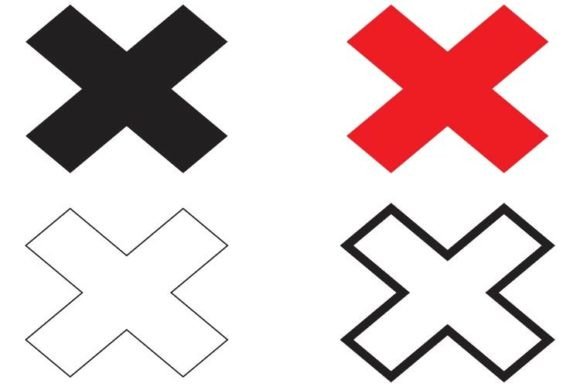
Understanding the X Sign Denied Rejection Collection for Professional Design Workflows
In the realm of graphic design and digital communication, clarity is paramount. Whether you are designing a user interface, drafting a corporate policy document, or creating marketing materials that require clear boundaries, the visual language of refusal needs to be immediate and unambiguous. The X Sign Denied Rejection Collection addresses this specific need by providing a comprehensive suite of icons dedicated to negation, cancellation, and prohibition. This asset pack is not merely a set of generic clip art; it is a curated resource designed for professionals who require consistency, high resolution, and versatility across various media formats.
For designers, marketers, and business owners, finding the right icon can often consume disproportionate amounts of time. Searching through disparate libraries leads to inconsistent line weights, mismatched styles, and varying resolutions. This collection mitigates those friction points by offering a unified aesthetic. With eighty-four unique designs available in both vertical and horizontal orientations, the pack ensures that you have the precise visual tool needed to convey "no," "stop," or "error" without disrupting the visual harmony of your project.
Technical Specifications and File Versatility
The true value of any digital asset lies in its usability across different platforms and print requirements. The X Sign Denied Rejection Collection is structured to support a wide range of professional workflows. Upon purchase, users receive a robust file structure that includes:
- 84 PNG files at 300dpi: These high-resolution raster images are ideal for web use, presentations, and documents where transparency is required. The 300 dots per inch resolution ensures that even when scaled moderately, the edges remain crisp and free from pixelation.
- 84 SVG files: Scalable Vector Graphics are essential for modern web design and responsive layouts. These files allow developers and designers to scale icons infinitely without loss of quality, making them perfect for mobile apps and retina displays.
- 4 EPS files: Encapsulated PostScript files contain all designs, offering compatibility with older vector software and specific printing workflows that prefer this standard.
- 1 AI file: The Adobe Illustrator file includes all designs, allowing for deep customization. Designers can edit anchor points, adjust stroke widths, or modify colors to match exact brand guidelines.
- 4 JPG files: These provide quick-access previews or simple usage scenarios where transparency is not necessary.
This diversity in file formats means that whether you are a web developer needing lightweight SVGs or a print designer requiring editable vectors for large-format signage, the collection adapts to your technical environment. The inclusion of both vertical and horizontal orientations for each design is a thoughtful detail. It acknowledges that space constraints in UI design or layout composition often dictate the aspect ratio of the icon, saving the user from having to manually rotate and rebalance elements.
Design Aesthetics and Visual Consistency
One of the most significant challenges in assembling a design toolkit is maintaining visual consistency. When icons come from different sources, they often clash due to variations in stroke thickness, corner radius, and overall weight. The X Sign Denied Rejection Collection solves this by adhering to a cohesive design language. Each of the eighty-four icons shares a common structural DNA, ensuring that if you use multiple symbols within a single project—such as a "delete" button next to a "prohibited" sign—they look like they belong to the same family.
The designs range from simple, minimalist crosses to more complex representations involving circles, shields, and hand gestures. This variety allows for nuanced communication. A simple red X might suffice for a close button, while a more elaborate denied stamp might be better suited for a legal document or a security warning. The aesthetic is clean and modern, avoiding overly decorative elements that could distract from the core message of rejection or denial. This neutrality makes the collection suitable for both corporate environments and creative startups.
Practical Applications in Business and Creative Projects
The utility of this collection extends far beyond basic error messages. In business contexts, clear visual cues can reduce confusion and improve user experience. Consider the following practical applications:
- User Interface (UI) Design: App and website developers can use these icons for form validation errors, deletion confirmations, and access restriction notifications. The SVG format ensures they load quickly and render sharply on all devices.
- Corporate Communications: HR departments and management teams can utilize these graphics in policy manuals, safety guides, and internal memos to highlight prohibited actions or outdated procedures. The professional look lends authority to the documentation.
- Marketing and Advertising: Marketers often use comparison charts to show what their product does not include or to debunk common myths. These icons serve as effective visual markers for "not included" or "false" statements, guiding the viewer’s eye efficiently.
- Educational Materials: Educators creating quizzes, worksheets, or instructional videos can use these symbols to indicate incorrect answers or unsafe practices. The clarity of the design helps learners grasp concepts quickly.
For freelancers and agencies, having a pre-vetted collection of high-quality rejection icons saves billable hours. Instead of creating these symbols from scratch for every client, designers can deploy assets from this collection, knowing they meet professional standards. This efficiency translates directly into better profit margins and faster turnaround times.
Evaluating Long-Term Value and Usability
When assessing the long-term value of the X Sign Denied Rejection Collection, one must consider its adaptability. Design trends evolve, but the fundamental need for clear negative indicators remains constant. The classic nature of the X symbol ensures that these icons will not appear dated in a few years. Furthermore, the ability to edit the AI and EPS files means that if a brand’s color palette changes, the icons can be updated instantly to remain compliant.
However, it is important to approach this resource with realistic expectations. While the collection offers eighty-four variations, they are all centered around the theme of denial. If a project requires a broader set of informational icons—such as arrows, checkmarks, or informational "i" symbols—this pack should be viewed as a specialized component rather than a complete icon library. It excels in its niche but is best used in conjunction with other complementary sets.
Usability is further enhanced by the organization of the files. Having separate folders for PNG, SVG, EPS, and AI formats prevents clutter and allows users to navigate directly to the file type they need. For non-designers, such as small business owners managing their own social media or blogs, the PNG files offer a drag-and-drop solution that requires no technical expertise. For professionals, the vector files provide the depth needed for high-end production.
Who Benefits Most from This Collection?
This resource is particularly well-suited for:
- UX/UI Designers: Who need consistent, scalable assets for digital products.
- Graphic Designers: Who work on diverse client projects and need reliable stock elements.
- Content Creators and Bloggers: Who want to enhance articles and tutorials with professional visuals.
- Small Business Owners: Who create their own marketing materials and need high-quality, ready-to-use graphics.
- Educators and Trainers: Who develop instructional content requiring clear visual cues for correct and incorrect actions.
In conclusion, the X Sign Denied Rejection Collection represents a practical investment for anyone involved in visual communication. It eliminates the guesswork associated with sourcing individual icons and provides a standardized, high-quality solution for conveying negation. By offering a blend of raster and vector formats, along with varied orientations and styles, it accommodates a wide array of professional needs. While it is a specialized tool, its execution is thorough, making it a valuable addition to any designer’s digital toolkit.