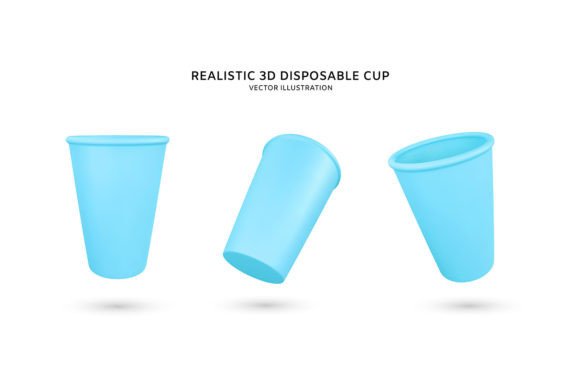
Evaluating the Realistic 3D Disposal Cup Digital Asset
In the realm of digital graphic design, the demand for high-fidelity assets that bridge the gap between three-dimensional realism and two-dimensional scalability is constant. The Realistic 3D Disposal Cup represents a specific category of vector illustration designed to meet this need. This asset is not merely a flat icon but a meticulously crafted representation of a disposable cup, rendered with depth, shadow, and texture to mimic real-world photography while retaining the mathematical precision of vector graphics. For designers, marketers, and content creators, understanding the technical specifications and practical applications of such an asset is crucial before integrating it into a broader visual strategy.
Understanding the Technical Composition
At its core, this product offers a dual-format solution: one EPS 10 file and one JPG file. The inclusion of the EPS 10 format is significant for professional workflows. EPS (Encapsulated PostScript) version 10 is a widely compatible vector format that ensures the artwork can be opened and edited in a vast array of design software, including older versions of Adobe Illustrator and CorelDRAW. This compatibility is a key consideration for agencies or freelancers who may not always operate on the latest software updates.
The accompanying JPG file serves a different purpose. It provides a rasterized, ready-to-use image for quick previews, web uploads, or situations where vector editing is unnecessary. However, the true value lies in the vector file. Described as a "100% Vector File," this means the artwork is constructed from paths, points, and curves rather than pixels. This distinction is vital for maintaining quality across different media sizes.
Key Benefits of Vector-Based Realism
The primary advantage of choosing a Realistic 3D Disposal Cup over a standard photograph or a basic flat icon is scalability. Because the file is vector-based, it can be scaled to any size without loss of quality. Whether the cup needs to appear on a small business card or a large-format trade show banner, the edges will remain crisp, and the gradients will stay smooth. This eliminates the common issue of pixelation associated with raster images when they are enlarged beyond their original resolution.
Furthermore, the asset is marketed as containing high-quality vector illustrations with separate elements. This modularity is a critical feature for customization. Designers often need to adjust specific components of an image to match brand guidelines or creative concepts. With separate layers or groups within the vector file, users can isolate the cup, the lid, the liquid inside, or the condensation droplets. This level of control allows for precise edits, such as changing the color of the coffee, adjusting the opacity of the steam, or removing background elements entirely.
Practical Applications and Use Cases
Identifying whether this asset aligns with your project goals requires looking at specific use cases. The Realistic 3D Disposal Cup is particularly well-suited for branding materials in the food and beverage industry. Coffee shops, cafes, and beverage manufacturers often require consistent imagery across menus, packaging, and digital ads. A vector asset ensures that the visual identity remains uniform regardless of the output medium.
Additionally, this asset is valuable for mockup creation. Designers creating packaging concepts or promotional materials can use the vector cup as a base layer, overlaying their own logos or designs onto the cup’s surface. Since the elements are separate, mapping a logo onto the curved surface of the cup becomes a more manageable task compared to working with a flattened photograph. It is also an excellent resource for educational materials or infographics related to sustainability, recycling, or consumer habits, where a clear, recognizable, yet stylized image of a disposable cup is needed.
Considerations and Tradeoffs
While the benefits are substantial, there are tradeoffs to consider. The primary requirement for utilizing the EPS file effectively is access to vector editing software. The product description explicitly states that if you want to edit, separate elements, or remove parts, you must use a vector editor like Adobe Illustrator or CorelDRAW. Users who rely solely on raster-based programs like Photoshop or free online tools may find the EPS file difficult to manipulate fully. While some programs can import EPS files, they often rasterize them upon import, negating the benefit of scalability and editability.
Another consideration is the learning curve associated with vector editing. Manipulating gradient meshes, anchor points, and transparency settings to maintain the "realistic" look while making changes requires a certain level of technical proficiency. For beginners, the complexity of a high-quality 3D-style vector might be daunting compared to a simple flat icon. Therefore, this asset is best suited for intermediate to advanced designers or those willing to invest time in learning basic vector manipulation techniques.
Comparing Alternatives
When evaluating the Realistic 3D Disposal Cup, it is helpful to compare it with alternatives. Stock photography offers true photorealism but lacks scalability and editability. Photos are fixed in resolution and lighting, making it difficult to integrate them seamlessly into various design layouts without extensive retouching. On the other hand, flat vector icons are easy to edit and scale but lack the depth and visual impact of a 3D-rendered style. They may appear too simplistic for premium branding or high-end marketing materials.
This vector asset occupies a middle ground, offering the aesthetic appeal of 3D rendering with the flexibility of vector graphics. However, if your project requires absolute photorealism with complex lighting interactions that change dynamically, a 3D model file (such as .OBJ or .FBX) used in rendering software like Blender or Cinema 4D might be a better choice. But for most 2D design applications, the EPS 10 file provides an optimal balance of quality and usability.
Making the Decision
To determine if this asset is the right fit for your needs, assess your technical capabilities and project requirements. If you have access to Adobe Illustrator or similar software and need a scalable, high-quality image of a disposable cup that can be customized, this product is a strong candidate. It is particularly useful for projects requiring consistent branding across multiple sizes and formats.
Conversely, if you do not have vector editing software or the skills to use it, the JPG file may suffice for simple, static uses, but you will miss out on the core benefits of the product. In such cases, a high-resolution stock photo might be a more straightforward alternative. Ultimately, the Realistic 3D Disposal Cup is a specialized tool for designers who value flexibility, scalability, and professional-grade aesthetics in their visual communications.